Pricing is one of the most powerful commercial levers in any business, but it is often treated as a decision that sits outside of the customer journey. In many companies, the price is set by the commercial team, added to the website or proposal, and only reviewed when conversion drops, monthly targets are missed, or pressure builds to increase revenue.
The reality, however, is that pricing decisions and the customer journey are inextricably linked.
Your customers encounter signals about price and value throughout the journey. In online purchasing, pricing signals often appear in places like search results; landing, product or pricing pages; checkout flows and upgrade prompts. In business-to-business (B2B) and enterprise sales, they may appear in marketing materials, sales decks, proposals, and sales conversations.
Each touchpoint shapes how customers understand value, compare alternatives, and build the confidence to move forward. Applying a pricing lens to the customer journey helps teams see where the journey is strengthening value perception, where it is encouraging price-led decisions, and where better framing could improve both customer understanding and commercial performance.
In this article, we explore how to:
- identify the pricing signals that shape how customers think about price, value and willingness to pay.
- spot the pricing touchpoints already present in your customer journey.
- review those touchpoints through a pricing lens.
- use strategy, research, and experimentation to improve outcomes without changing the price.
What is a pricing signal?
A pricing signal is any moment in the customer journey that shapes how a customer thinks about price, value or willingness to pay.
Some pricing signals are easy to spot, appearing as a number with a currency sign or percent: Save £99. Now $49. €20 off. 20% off your first order.
Other signals are less obvious. They don’t mention price directly, but do shape what customers expect to pay and how the price feels when they see it:
-
BrandA budget hotel and a luxury hotel create very different expectations before a customer sees a room rate. One signals efficiency, simplicity and low cost. The other signals quality, service, status and experience. Both prepare customers to judge price in completely different ways.
-
Value positioningHow you position the offer shapes what customers believe they are paying for. For example, “AI-driven insights” creates a different expectation from “tailored advice from an expert team.”
-
Proof pointsTestimonials, case studies, reviews, accreditations and performance claims all influence whether the price feels fair and shape the perceived risk of buying. A customer who sees strong evidence of results will judge price differently from one who is making a seemingly unguided decision.
-
Service cuesDelivery times, onboarding, support levels, response times and guarantees all signal added value and can change how customers interpret the price.
-
Choice signpostingLabels and defaults help customers make sense of their options and create decision-making shortcuts. For example, a “most popular” badge can quickly give customers confidence that they are making a good decision.
Together, these signals create the context in which price is judged. That’s why the same price can feel expensive, fair, risky or good value depending on what surrounds it.
What pricing touchpoints should I watch for across the customer journey?
Pricing touchpoints are the moments where pricing signals appear in your customer journey.
These touchpoints often already exist across your digital, physical or sales experience. The opportunity is to bring them together as a pricing layer on your customer journey map, so you can review the journey through a pricing lens.
This pricing lens helps you see where customers form expectations about value and where the journey may be creating friction or pushing them towards less desirable outcomes.
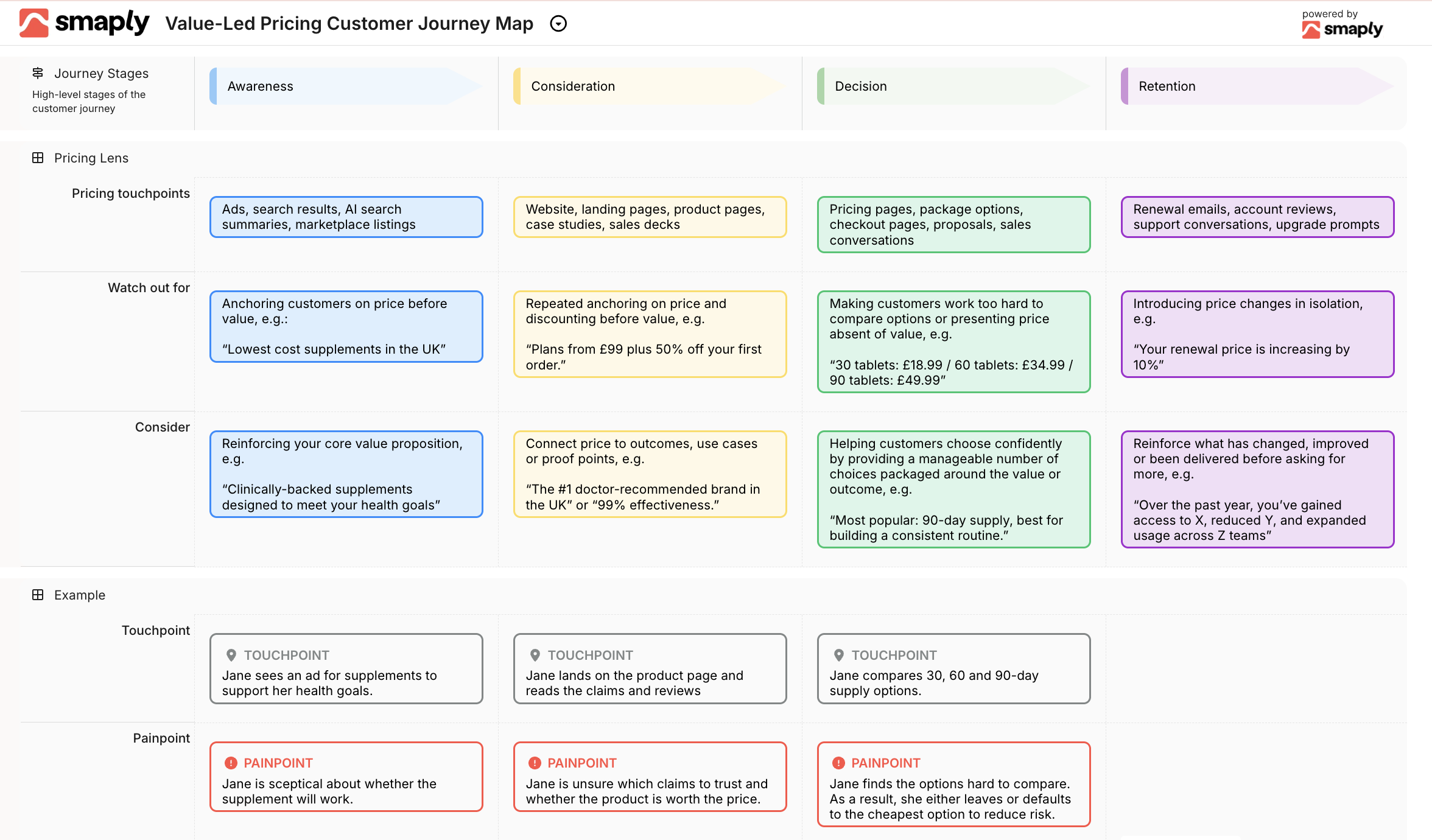
The table below maps some common touchpoints across the awareness, consideration, decision and retention stages.
| Stage | Pricing touchpoints | Watch out for | Consider |
|---|---|---|---|
| Awareness | Ads, search results, AI search summaries, marketplace listings | Anchoring customers on price before value, e.g. “Lowest cost supplements in the UK” | Reinforcing your core value proposition, e.g. “Clinically-backed supplements designed to meet your health goals” |
| Consideration | Website, landing pages, product pages, case studies, sales decks | Repeated anchoring on price and discounting before value, e.g. “Plans from £99 plus 50% off your first order.” | Connect price to outcomes, use cases or proof points, e.g. “The #1 doctor-recommended brand in the UK” or “99% effectiveness.” |
| Decision | Pricing pages, package options, checkout pages, proposals, sales conversations | Making customers work too hard to compare options or presenting price absent of value, e.g. “30 tablets: £18.99 / 60 tablets: £34.99 / 90 tablets: £49.99” | Helping customers choose confidently by providing a manageable number of choices packaged around the value or outcome, e.g. “Most popular: 90-day supply, best for building a consistent routine.” |
| Retention | Renewal emails, account reviews, support conversations, upgrade prompts | Introducing price changes in isolation, e.g. “Your renewal price is increasing by 10%” | Reinforce what has changed, improved or been delivered before asking for more, e.g. “Over the past year, you’ve gained access to X, reduced Y, and expanded usage across Z teams” |
To make this concrete, a pricing layer on the journey of someone buying supplements online might look something like the table below.
| Stage | Awareness | Consideration | Decision |
|---|---|---|---|
| Touchpoint | Jane sees an ad for supplements to support her health goals. | Jane lands on the product page and reads the claims and reviews | Jane compares 30, 60 and 90-day supply options. |
| Painpoint | Jane is sceptical about whether the supplement will work. | Jane is unsure which claims to trust and whether the product is worth the price. | Jane finds the options hard to compare. As a result, she either leaves or defaults to the cheapest option to reduce risk. |
| Pricing hypothesis for testing | “#1 doctor recommended” reassures Jane better than “Lowest cost supplements in the UK”. | Proof points and reviews increase conversion more than an early discount. | Signposting the most popular option helps Jane choose with more confidence. Showing the expected time to results helps Jane understand the value of committing for longer. |
In a journey-mapping tool, that pricing layer becomes part of the map rather than a separate table. The example below is built in Smaply, with the pricing touchpoints, watch-outs and test hypotheses sitting directly on the customer journey.
How pricing signals align with your commercial strategy
In the table above, you’ll notice a shift away from anchoring on price. Whether or not this is the right call for you depends on your commercial strategy.
If your strategy is to be the low-cost leader, then leading with price may be exactly the right move. Brands like Ryanair and Lidl use price as a clear indicator of their market position.
However, if your intended position is to be a premium lifestyle brand, then leading with price may be working against you. It trains customers to compare costs before they understand why and how the offer differs from lower-cost alternatives.
Premium brands – think Apple or The Ritz-Carlton – rarely lead with discounts. Instead, they lead with messaging about quality, design, innovation, service, exclusivity or status. By the time the customer sees the price, they already believe the offer is worth more.
Add a pricing layer to your journey map and review the touchpoints that shape what customers expect to pay.
How to evaluate your journey map with a pricing lens
The first step is identifying the pricing touchpoints that are critical to your customer experience. Next, review how these influence the customer journey and your commercial outcomes by bringing together three inputs:
1. Commercial strategy
Start with the position you are trying to own in the market. Are you competing on low cost, premium quality, specialist expertise, convenience, flexibility, speed, reduced risk or something else? This position should guide how price and value show up across the journey.
Use your commercial strategy to ask: Does this touchpoint reinforce the position we want to own?
2. Customer research
Next, look at how customers experience the journey through a pricing lens.
Customer interviews can help you understand how people interpret specific touchpoints: what they notice, where they feel reassured, and where they start to question the value. They are especially useful for understanding the “why” behind price perception.
Surveys can then help you validate those patterns at scale. They can show which value messages resonate most, which benefits customers are willing to pay more for, and how different segments respond to each.
This is a critical step in your pricing review because internal teams often overestimate the role of price in purchase decisions. While price is important, it is rarely the only factor customers are weighing. Speed, certainty, trust, convenience, expertise, reduced risk, service quality, or measurable outcomes regularly outweigh price in purchase decisions.
Research helps identify the gap between what internal teams believe customers value and what customers actually use to make decisions. It gives you the insight you need to make evidence-led decisions about how to change your messaging, price presentation and customer journey.
Use research to ask: How does the customer experience impact willingness to pay?
3. Experimentation
Finally, test and learn how changes to pricing touchpoints affect behaviour and outcomes.
Small changes to how a price is framed and how choices are presented can have just as big a commercial impact as changing the price itself.
In an online journey, this might mean A/B testing pricing page layouts, package descriptions, “most popular” labels, or value messages.
In an enterprise B2B journey, it might mean testing proposals that offer three options at different price points rather than one. It could be changing the sales scripts to reframe how and when price is introduced in the sales process.
Running experiments helps build the evidence the business needs to prove that changes to the customer experience, user experience or sales journey can have a measurable commercial impact.
Use experiments to ask: What small changes can have a big impact on customer behaviours and business outcomes?
How to use pricing as a commercial lever in journey management
If you’re reading this, you probably already know that the experience a customer has directly affects conversion, retention, willingness to pay and, ultimately, business growth. But that connection is not always visible across the business.
Adding a pricing layer to your journey map can make the commercial impact easier to see, discuss and act on. It also makes pricing part of ongoing journey management, so the business can respond more strategically as markets shift, competitors change, customer expectations evolve, and the product or service develops.
The goal is not to turn every journey map into a pricing project. It is to recognise that price perception is already being shaped throughout the journey. By making those moments visible, teams can unlock more of the value they already create.
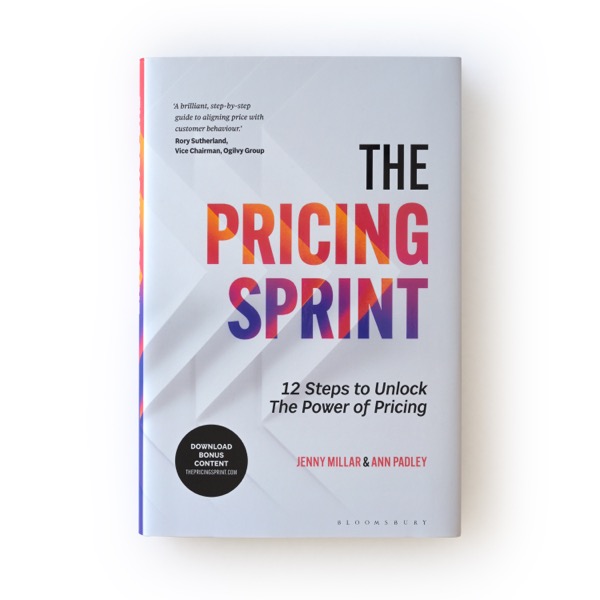
Learn how to harness the power of pricing in your commercial strategy
Pricing is shaped by two connected journeys: the internal journey teams follow to set, present and manage price, and the external journey customers go through as they interpret value, assess risk and decide whether to buy.
About the authors
Ann is Senior Partner at Untapped Pricing and a strategist specialising in human-centred design and behavioural science. Jenny is Founder of Untapped Pricing and a former eBay executive who has led major pricing transformations across Europe. Together, they help leadership teams understand how human behaviour inside and outside the business shapes pricing decisions, performance and profit.