Unlike isolated campaign execution or channel-based optimization, customer journey orchestration focuses on aligning people, processes, and touchpoints around shared customer journeys. It builds on journey mapping and journey management to ensure that experiences are not only designed – but also coherently delivered.
What Is Customer Journey Orchestration?
Customer journey orchestration is the coordinated alignment of customer interactions across channels, teams, and moments in the journey, based on a shared understanding of customer needs and intent.
In practical terms, journey orchestration means:
- Knowing where a customer is in their journey
- Understanding what matters at that moment
- Ensuring the right team or system responds appropriately
- Maintaining consistency across touchpoints over time
Journey orchestration is not limited to automation or real-time personalization. It also includes strategic coordination, governance, and decision-making across the organization.
Related terms often used interchangeably—but not identically—include:
- Journey orchestration
- Orchestrating customer journeys
- Journey-based orchestration
Journey Mapping vs. Journey Management vs. Journey Orchestration
Although closely connected, these concepts serve different purposes.
Journey Mapping
Journey mapping focuses on understanding and visualizing customer experiences.
- Documents steps, touchpoints, emotions, and pain points
- Creates a shared view of the customer perspective
- Is typically static or point-in-time
Journey Management
Journey management focuses on governing and evolving journeys over time.
- Assigns ownership and accountability
- Keeps journeys updated as products, channels, or customer needs change
- Connects journey insights to business decisions
Journey Orchestration
Journey orchestration focuses on coordinating actions along the journey.
- Aligns teams, systems, and decisions across touchpoints
- Depends on strong journey mapping and journey management
- Translates journey insight into coordinated experience delivery
You map journeys to understand the customer experience, manage journeys to keep them relevant, and orchestrate journeys to deliver them consistently.
Why Customer Journey Orchestration Matters
Organizations increasingly struggle with fragmented customer experiences caused by siloed teams, disconnected systems, and inconsistent decision-making.
Customer journey orchestration helps address these challenges by enabling:
- Consistency across touchpoints
Customers experience fewer contradictions between channels and interactions. - Reduced organizational silos
Teams align around shared journey context rather than isolated KPIs. - Clear ownership of key moments
Critical moments in the journey have defined responsibility. - Better decision-making
Actions are informed by journey context, not just channel performance.
As customer journeys become more complex, orchestration becomes essential to maintaining experience quality at scale.
How Customer Journey Orchestration Works (Conceptual Model)
Customer journey orchestration is best understood as an ongoing capability rather than a one-time implementation.
A typical orchestration approach includes:
- Map customer journeys to understand the experience a customer or user goes through.
Create shared, journey-based representations of customer experiences. - Establish journey ownership and a governance structure
Define who is responsible for journey outcomes and evolution. - Identify dependencies across teams and touchpoints
Understand where coordination is required to avoid experience breakdowns. - Coordinate actions along the journey
Align interactions, decisions, and timing across channels and teams. - Monitor, adapt, and improve continuously
Use feedback and insights to refine orchestrated journeys over time.
This model keeps orchestration strategic, adaptable, and customer-centered.
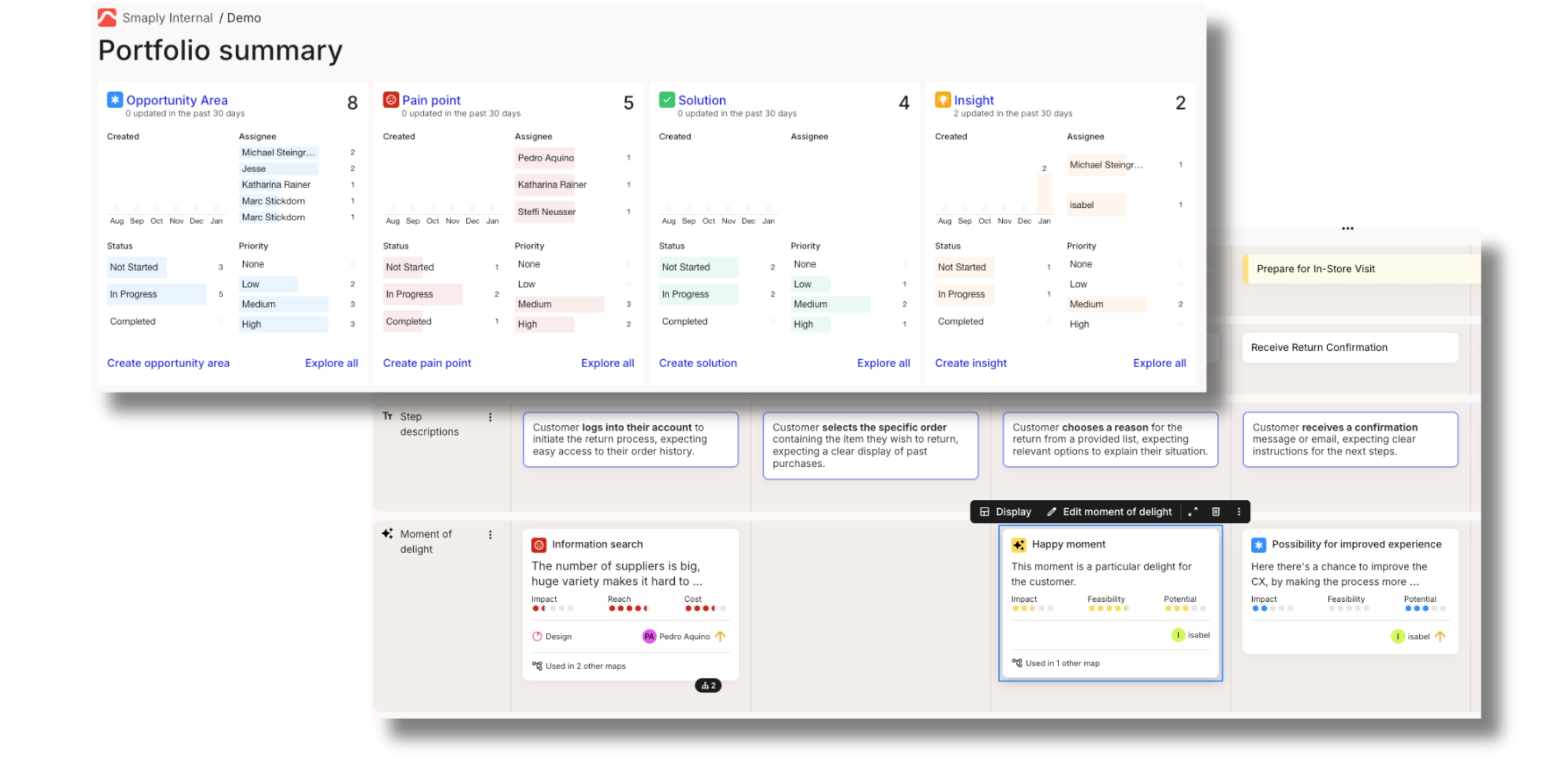
Smaply gives your teams one shared view of every customer journey, so actions stay aligned across touchpoints.
Customer Journey Orchestration Tools and Software
Customer journey orchestration tools and customer journey orchestration software support organizations in designing, aligning, and coordinating journeys across teams and systems.
While capabilities vary, these tools typically support:
- Journey modeling and visualization
- Cross-functional collaboration
- Alignment between journey insight and execution
- Governance and journey ownership
- Integration with analytics and operational systems
Importantly, journey orchestration software does not replace journey thinking. It amplifies it by enabling coordination at scale.
What to Look for in a Journey Orchestration Platform
A journey orchestration platform should support the organization’s journey maturity—not force a channel-centric or tool-driven approach.
Key evaluation criteria include:
- Journey-first orientation, not channel-first design
- Support for journey management, including governance and ownership
- Cross-functional collaboration, beyond marketing or CX teams
- Scalability across multiple journeys, possibility to create journey map repositories and hierarchies
- Flexibility to evolve as customer needs and organizational structures change
The best platforms enable orchestration without oversimplifying complex journeys.
Common Challenges in Customer Journey Orchestration
Many orchestration initiatives struggle due to organizational, not technical, barriers.
Common challenges include:
- Siloed teams and fragmented ownership
- Lack of a shared journey language
- Tool fragmentation across departments
- Missing governance structures
- Treating orchestration as a project rather than a capability
Successful orchestration requires alignment, clarity, and long-term commitment.
Best Practices for Effective Journey Orchestration
Organizations that succeed with journey orchestration typically:
- Start with clear, shared journey understanding
- Anchor orchestration in journey management practices
- Align teams around moments that matter
- Treat journeys as living systems, not static flows; create a framework for customer journeys
- Continuously refine orchestration based on insight and feedback
These practices ensure orchestration remains relevant and scalable.
How Smaply Supports Customer Journey Orchestration
Smaply supports customer journey orchestration by providing the foundation for journey understanding and journey management.
Rather than focusing on execution automation, Smaply enables organizations to:
- Create shared journey representations
- Align teams around customer perspectives
- Establish governance and ownership of journeys
- Maintain clarity across complex journey ecosystems
This foundation allows organizations to orchestrate journeys effectively—because coordination is only possible when journeys are clearly understood and managed.
Conclusion
Customer journey orchestration is the natural evolution of customer experience work. It connects journey insight, organizational alignment, and coordinated action across the entire customer lifecycle.
By building on journey mapping and journey management, orchestration enables organizations to deliver consistent, meaningful experiences—despite growing complexity.
As customer expectations rise, the ability to orchestrate journeys thoughtfully and sustainably will define experience leaders.
Ready to get your hands dirty?
Start orchestrating your own customer journeys with Smaply. For free, forever.