
Mature CX flips this narrative by connecting valuable data, feedback, behavior analytics, and team decisions. Instead of reacting to pain, you anticipate it. Instead of chasing satisfaction scores, you drive measurable business outcomes through deliberate, insight-led actions.
In this article, we’ll share six tips to help your organization achieve CX maturity.
Stop Collecting Data You Don’t Use
Most companies collect a lot of information from their customers, including what they do and don't need. However, hoarding so much data isn’t always a good thing.
- First, too much bulkiness increases your data storage and analysis costs. An avoidable expense and also not sensible from a sustainability perspective because data storage requires large amounts of energy.
- It’s easier to overlook crucial information.
The data that goes unused is cheekily called dark data by the industry. A recent survey of over 1300 businesses and decision-makers found that over 50% of a company’s data is considered dark. In one third of cases, the amount of dark data went up to 75%.
So, it’s not about how much you collect but how well you can use them to drive customer experience.
Mature CX treats data as an engine, not boastful numbers or decorations. So, when building your database:
- Focus on those driving revenue-impacting decisions, not unused reports
- Every insight must connect to a tangible outcome. That includes improving retention, reducing churn, or optimizing product experience.
- Page views, likes, impressions, and survey response counts that don’t reveal customer intent or predict retention are vanity metrics. Still, they do provide crucial context for top-of-funnel performance and brand health. So keep an eye on them, but don’t store them indefinitely.
Most importantly, review data relevance periodically to purge obsolete or low-impact metrics and declutter your dashboard.
Manage Your Clients’ Journey
All the data in the world doesn’t mean much if you don’t use it to improve your CX.
Today’s monitoring and data analytics tools are advanced enough to show you a visitor’s journey through a particular product/service page, and their point of exit.
You also have customer journey maps that give you a better understanding of touchpoints between buyers and your brand (social media, website, review sites, etc.), the emotions involved at each stage of the funnel, and possible customers’ pain points with the industry or specific products/services.
Now, whether a customer converts depends on how you use this information to understand and anticipate their needs, preferences, and behaviors. You want to be present and help your audience at every step of their journey through timely messages and interactions.
The goal is to meet your customers' needs every step of the way, across all touchpoints and channels. This way, you create a seamless personalized experience throughout the customer lifecycle, and strategically align operations around the customer journey so the core of your organization’s activities is the customer journey. This is what we call Customer Journey Management (CJM).
So, instead of saying “customers drop off after sign-up,” and accepting this as a fact, it’s important to ask why, study the behavioral data, and test different onboarding flows to fix it.
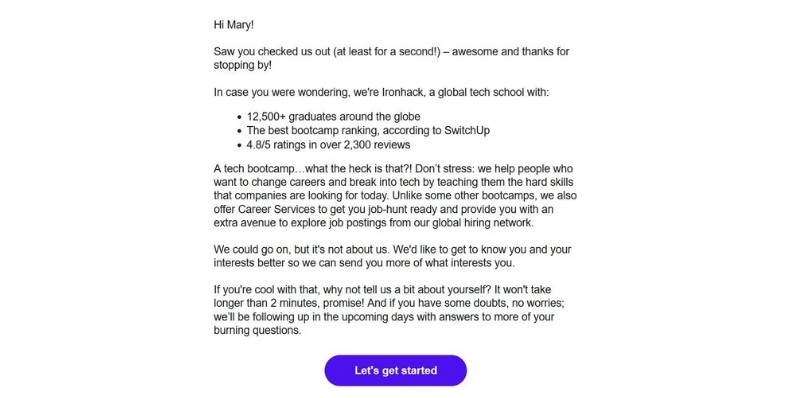
See how Ironhack, an education niche platform, did that to get a potential student back to the tech bootcamp with the following email: “Saw you checked us out (at least for a second!)—awesome and thanks for stopping by!”
While other brands would have sent a generic “Come back to complete checkout” message, Ironhack studied the time spent and realized the lead might not have understood their value proposition.
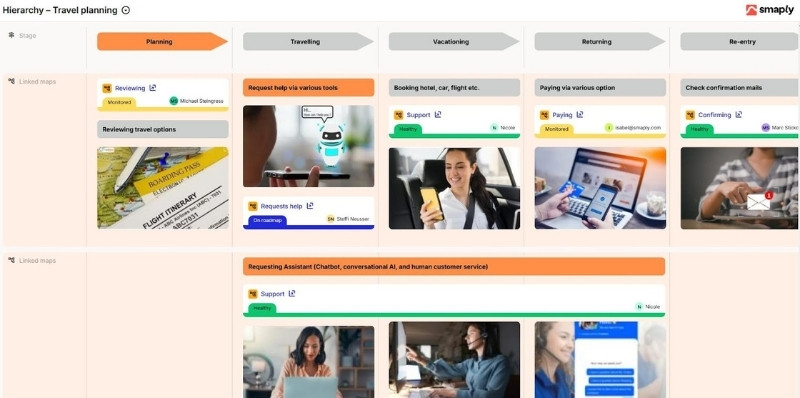
CJM combines journey mapping with insights from customer journey analytics. Mapping gives you a bird’s-eye view of all the channels, and analytics fills in the blanks with insightful information.
To get a broad understanding of your audience, you have to think beyond your website. This also includes analyzing customer newsletter behavior via email analytics, monitoring engagement patterns across social media, and observing purchase or browsing behavior on your app.
Then connect all these signals into a unified system, such as a CRM, to drive personalization and address predictable customer behavior.
Empower Employees to Make Decisions
Creating a negative customer experience takes only seconds.
For instance, a customer stuck on hold because an agent needs managerial approval for a simple refund can lose trust immediately.
Minor delays like this quietly chip away at loyalty and satisfaction. The best way to avoid this? Empower your staff to make quick, customer-focused decisions without waiting for endless approvals or rigid policies.
For example:
- A hotel receptionist can offer a free room upgrade to fix a booking error instead of calling a manager
- A call-center agent can waive a small late fee to retain a loyal customer
- A delivery team can reroute a shipment immediately when a customer changes their address
This also creates a good employee experience, which spills over into the customer experience. When employees are happy and motivated, they are more engaged and invested in their work. This leads to them providing better service, being more empathetic when solving customer problems, and offering personalized interactions.
A positive work environment also reduces employee turnover, which lowers the company's costs (fewer recruiting and onboarding expenses). Overall, happy employees lead to happy customers and increased revenue. It’s a win-win-win situation!
Use Technology as a Multiplier, Not a Crutch
Imagine there’s a cup that can fall and break into pieces. Immature CX teams react only when the cup is already broken, and sometimes irreversibly.
In contrast, mature ones tap into a predictive rather than a reactive tech stack to prevent the cup from falling in the first place.
Translate this cup to customer experience, you'd have successfully:
- Saved your customers from churning
- Avoided spending on acquiring new leads
- Increased overall customer lifetime value (CLV)
Here’s where you leverage the power of technology and AI to gain a better understanding of potential tension points in your CX strategy. Smart tools like AI-powered analytics and journey systems are a great point to start.
Beyond this, you can also use predictive competitive analytics tools to monitor your competitors’ page updates, product releases, customer reviews, sentiment shifts, and support trends. This helps you understand how others shape their customer experience and where they are heading.
So, if CX tools show you your customers’ next move, then competitive analytics will predict the market’s next move. Combine both, and you will effortlessly reshape your customer experience.
Measure Value, Not Sentiment
Most CX programs measure satisfaction scores, star ratings, and Net Promoter Scores.
The thing is, these metrics are helpful, but they don't tell you whether your business is actually growing because of CX.
To truly achieve customer experience maturity, your questions need to include “Did that happiness lead to better retention, higher lifetime value, or stronger revenue stability?” and not stop at “Are customers happy?”.
That's why you should track metrics, such as:
- Customer retention rate to know how many customers choose to stay over time
- Customer lifetime value (CLV) is used to measure the total revenue a customer contributes throughout their relationship with your brand
- Net revenue retention (NRR) is used to understand how much recurring revenue you retain and expand within your existing customer base
- Churn rate to see how many customers leave and how it impacts your recurring revenue
- Expansion revenue from cross-sells or upsells shows how well you nurture customer relationships
Other valuable metrics include advocacy rate and revenue per customer segment.
Qualitative data is also important because it gives you "why" behind the quantitative metrics. While efficiency often implies speed and cost (quantitative), qualitative data reveals how frictionless the process felt to the customer, which is the true measure of CX efficiency.
Here are a few examples of qualitative data you should keep in mind and why:
- Open-ended survey responses can reveal specific friction points that don’t surface otherwise. Something like "The product is great, but it took three days and four phone calls to update my billing address," shows that, despite a positive outcome, the customer experienced frustration.
- Online reviews are perfect to identify the strengths and weaknesses of your CX.
- Customer support notes can give you a feel of the internal inefficiency of the organization as experienced by the customer. If a customer notes they appreciate your agents’ politeness, but they kept getting transferred between departments and they had to explain their issue from scratch every time," this shows poor knowledge management, lack of system integration, and a low First Contact Resolution (FCR) rate.
By analyzing the themes, sentiment, and specific language within this data, you can identify the root causes of customer effort and fix them, making the entire journey more efficient from the customer's perspective.
CX Maturity Needs Maintenance
Let’s say you managed to implement a customer-centric framework that has satisfactory results. Data shows customers appreciate your efforts, sales are growing, and employees are engaged.
But is that it?
Not really. Customer satisfaction doesn’t last if it’s not maintained. And today’s consumers aren’t shy or timid — a recent Emplifi survey found that 46% of consumers will leave a brand after just two bad experiences.
This means that once you reach a level of CX maturity, your efforts must focus on maintaining and improving it.
Prioritize, Prioritize, Prioritize
You won’t always be able to tackle all fronts. But not all battles are equally important. Use the CX tools at your disposal to understand which improvements to prioritize to best meet customer needs and reap the most benefits.
For instance, prioritizing the management of your contact center performance helps you identify bottlenecks, optimize agent efficiency, and ensure that every interaction aligns with your overall business objectives.
Adopt Total Experience (TX)
A recent report shows that businesses worldwide lose about $4 trillion in sales due to poor experiences. And it’s not like they are not trying. These losses creep in slowly because some important areas remain neglected.
A TX strategy goes beyond simply focusing on the customer by holistically weaving together four core disciplines:
- Customer Experience (CX): The interactions and relationship with the customer.
- Employee Experience (EX): The internal environment, tools, and culture for employees.
- User Experience (UX): The usability, design, and functionality of products/services.
- Multi-Experience (MX): Ensures seamless, consistent interactions across all channels and devices (web, mobile, voice, AR/VR).
In a mature TX organization, the principle is: improving one area positively impacts all others. For example, improving an employee's internal software (EX/UX) makes their work easier, leading to faster, more helpful service for the customer (CX). It breaks down silos to create a single, cohesive experience.
Wrapping up
CX maturity means getting to a stage where customer data fuels your initiatives, interactions feel effortless, all departments become customer-centric and work in tandem, and customer satisfaction drives real revenue.
To achieve that, be data-driven and ensure you collect only the needed pieces, institutionalize CX accountability across your teams, and evolve your customer journey map into a journey science.
In addition, empower your employees to make valuable decisions autonomously, leverage CX technology as a multiplier, and measure value-driven metrics.